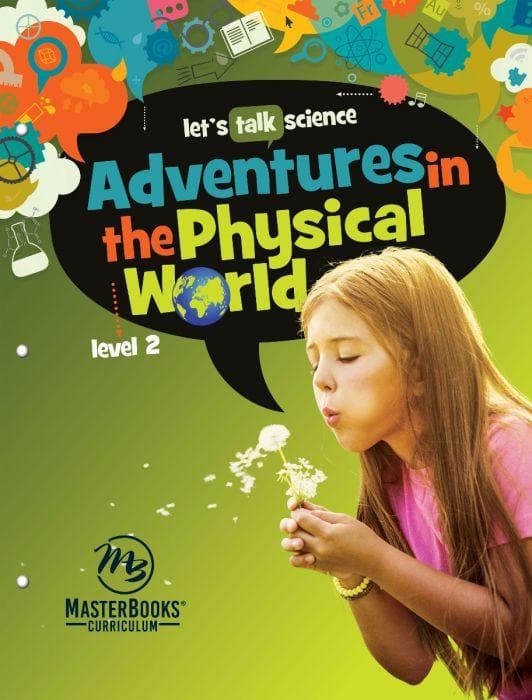
Adventures in the Physical World: Level 2
Original price was: $99.99.$29.99Current price is: $29.99.
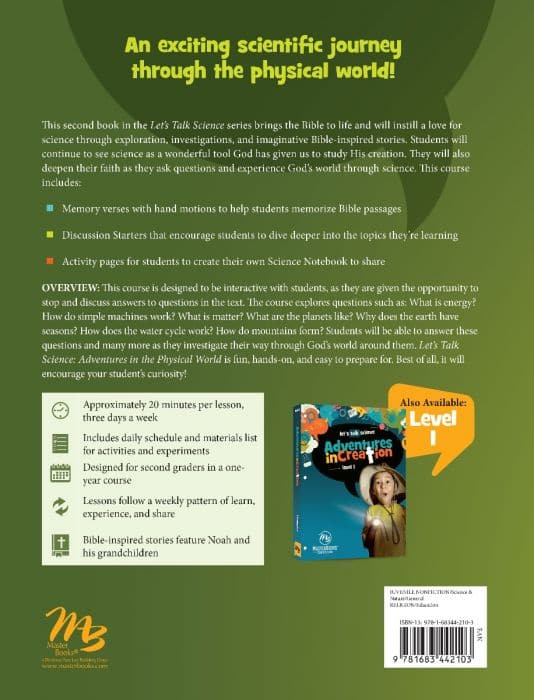
Guide your students on an exciting scientific journey through the physical world!
Adventures in the Physical World is an early elementary science curriculum designed to instill a love for science and bring the Bible to life. Through hands-on investigations and biblically inspired stories, students will explore and experience God’s fascinating world as they study energy, force, simple machines, matter, astronomy, meteorology, and geology. Their faith will grow as they discover they learn that science supports what they read in the Bible.
This course is hands-on fun, easy to prepare for, and it will encourage your student’s curiosity! Second grade level students can complete the lessons in approximately 20 minutes. This one-year course is designed to be studied three times a week.
This course includes:
- Memory verses with hand motions to help students memorize Bible passages
- Discussion Starters that encourage students to dive deeper into the topics they’re learning
- Activity pages for students to create their own Science Notebook to share
For ages 6-8.
360 pages.
View excerpt here.
Course Objectives
Students completing this course will:
- Explore energy, force, motion, simple machines, matter, astronomy, meteorology, and geology
- Discover that science teaches many lessons about God and our relationship with Him
- Learn through hands-on exploration and experimentation
- Compile a Science Notebook as students document their discoveries and share what they’ve learned with others
Course Overview
This course is designed to be interactive with students, as they are given the opportunity to stop and discuss answers to questions in the text. The course explores questions such as:
- What is energy?
- How do simple machines work?
- What is matter?
- What are the planets like?
- Why does the earth have seasons?
- How does the water cycle work?
- How do mountains form?
Students will be able to answer these questions and many more as they investigate their way through God’s world around them.
Adventures in the Physical World is Level Two of the Let’s Talk Science curriculum designed to teach children how science supports the Biblical account of God’s creation.
Table of Contents
- 1. The Physical World
- 2. Potential and Kinetic Energy
- 3. Mechanical Energy
- 4. Friction and Force
- 5. Pulleys
- 6. Gears
- 7. Levers
- 8. Chemical Energy
- 9. Matter
- 10. Magnets
- 11. Electrical Energy
- 12. Thermal Energy
- 13. Light Energy
- 14. Nuclear Energy
- 15. The Sun
- 16. Moon
- 17. Stars
- 18. Constellations
- 19. The Solar System 1
- 20. The Solar System 2
- 21. Intro to Meteorology
- 22. Weather Instruments
- 23. The Atmosphere
- 24. Clouds 1
- 25. Clouds 2
- 26. The Water Cycle
- 27. Seasons
- 28. Intro to Geology
- 29. Earthquakes
- 30. Mountains
- 31. Volcanoes
- 32. Igneous Rocks
- 33. Sedimentary Rocks
- 34. Metamorphic Rocks
- 35. Fossils
- 36. Conclusion