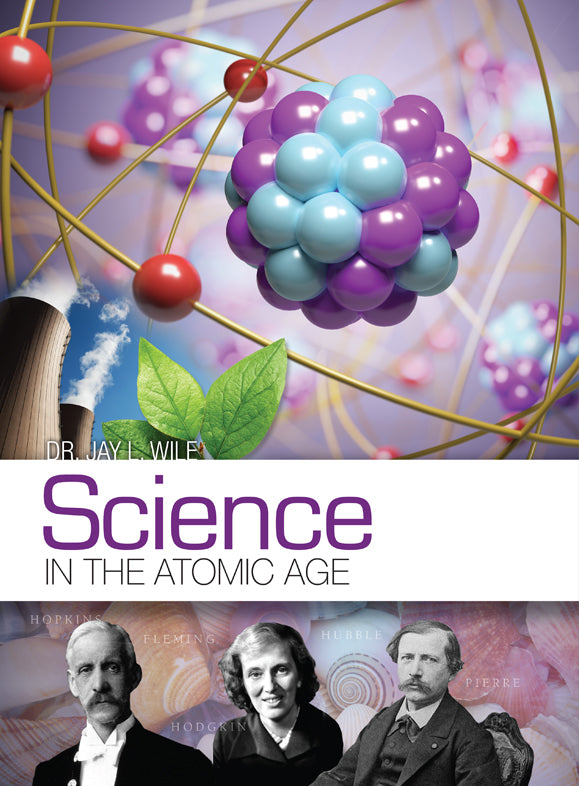
Science in the Atomic Age
Original price was: $189.99.$56.99Current price is: $56.99.
This laboratory-based, junior high science course covers a wide range of topics that are of interest to modern scientists. It starts by describing our current understanding of atoms, molecules, the chemicals that are necessary for life, DNA, and cells. These topics are all discussed in the context of history, explaining how specific scientific advances led to the scientific explanations that the students are being taught. This allows students to learn not only the current scientific understanding of these topics, but also how scientists reached that understanding.
The course then uses what the student has learned to describe the living world. It discusses the levels of organization found in creation and spends time discussing topics at each level. As a result, students learn how cells work together to make tissues, how tissues come together to make organs, how organs form organ systems, how those organ systems produce organisms, and how those organisms relate to one another in populations and communities. The student then learns how those communities interact with the physical environment to form ecosystems, which then form biomes. Along the way, students learn about fascinating new discoveries such as the function of the human appendix, the human microbiome, and soft tissue found in dinosaur fossils. Throughout the course, God’s design in nature is highlighted, and topics in the creation/evolution debate are discussed.
This course is focused on learning through experiments and other hands-on activities. While students will not do an experiment or activity every day they do science, they will have more days with an experiment or activity than days without one. Experiments and activities use household items or things that are sold in supermarkets, drug stores, or hardware stores. The course is laid out so that the student knows what to cover each day, and most students will need to work an average of about 30-45 minutes every day of the week to cover the course in a year.
Unless you are using this course with someone else and they have the Solutions and Tests manual you may want to order that as well.